
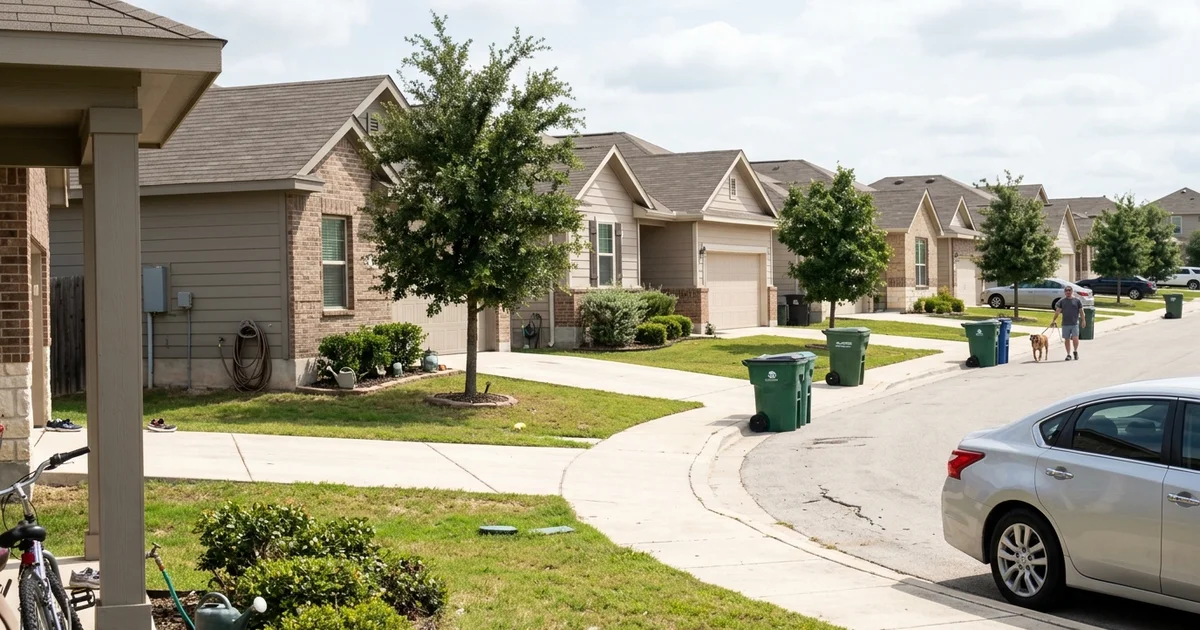
Why HOA Paint Color Approval Comes First
HOA paint color approval comes first because skipping it violates your legally binding deed restrictions. You could face daily fines or be forced to repaint at your own expense.
We see homeowners underestimate this step constantly, which throws off their entire renovation schedule.
In 2026, the Community Associations Institute reports that over 370,000 HOAs govern roughly 77 million Americans, making these strict architectural rules more common than ever. Many communities around Austin require formal permission, including popular neighborhoods in:
- Round Rock
- Cedar Park
- Georgetown
- Pflugerville
Our goal is to help you secure your HOA paint color approval on the first try so your exterior painting project stays on schedule.
Let us break down the exact steps, required documents, and timeline strategies you need to know.
Step 1: Read Your Covenants
Step one is locating your community’s Declaration of Covenants, Conditions, and Restrictions (CC&Rs) to find the rules for exterior modifications. This document outlines exactly what your Architectural Review Committee (ARC) demands.
Our team always checks these rules first because Texas Property Code Chapter 209 gives these committees significant legal authority.
You need to look for several key details in your governing documents.
- Whether paint changes require formal approval.
- Whether repainting the identical color needs a quick notice.
- Any pre-approved color palette lists.
- Specific application requirements and forms.
- The mandated response time for the committee.
We recommend logging into management portals like TownSq or Smartwebs to download these documents quickly.
If you cannot find them online, a quick email to your management company usually does the trick.
Step 2: Check for an Approved Palette
Finding HOA approved paint colors is your fastest route to a green light. Many HOAs publish specific pre-approved schemes grouped by body, trim, and accent colors.
We highly recommend checking the Sherwin-Williams HOA Color Archive online.
This public database stores thousands of approved neighborhood palettes across the US. Using an exact match from an approved scheme usually guarantees rapid approval.
Why Palettes Matter Choosing custom colors outside the palette often triggers a lengthy review process. You will typically need to provide significant justification and neighborhood context if you stray from the official list.
Our designers always start by matching your vision to the closest pre-approved option.
Step 3: Pick Colors and Make Samples
Even within an approved list, you must pick final colors and create physical samples to verify they look right on your property. Colors look drastically different on a tiny paper chip compared to a large stucco wall. If your facade has stone, also decide whether to paint, limewash or leave limestone and brick accents natural before you submit.
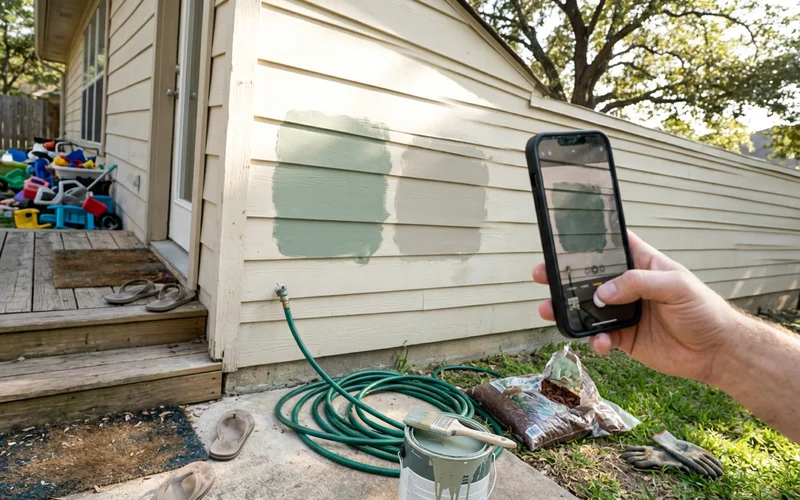
Our teams insist on painting large sample patches directly on the siding to test different lighting conditions.
Many architectural committees are now rejecting applications that only include digital renderings. Check out this guide to choosing colors for a full, step-by-step sampling method, and prepare these items for your submission:
- Exact names and codes (e.g., SW 7006 Extra White) for body, trim, and accents.
- A physical sample board or painted wall patches.
- Current photos showing your home’s existing scheme.
- Sample photos showing the new colors applied to your actual house.
We always review these items twice before submitting.
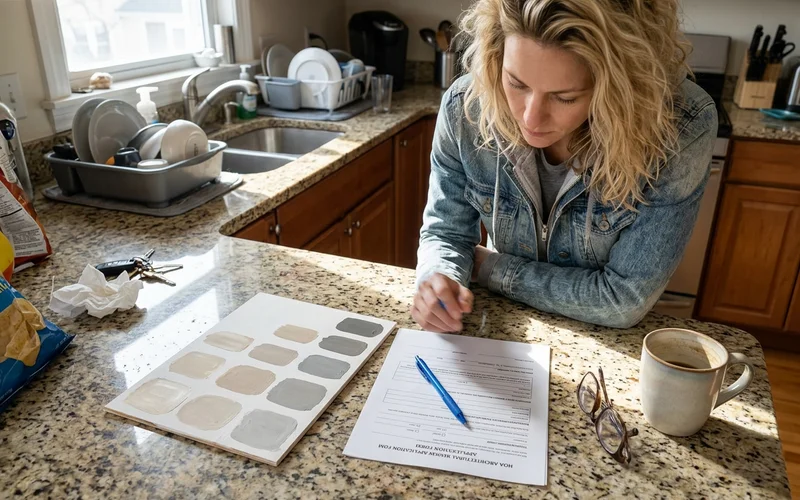
Step 4: Submit the Application
Submitting the application requires filling out your specific HOA architectural review paint form and attaching all your sample photos. Include every requested detail to prevent an immediate rejection.
We suggest adding a detailed site map that clearly labels which architectural features receive which specific paint code.
Digital Tracking Documenting the exact submission date is crucial for holding the committee accountable to their legal response deadlines. Always keep a digital copy of your entire package.
Our project managers always ask for an email receipt or a tracking number when using platforms like AppFolio.
This simple habit prevents your application from getting lost in the system.
Step 5: Wait for the Decision
Waiting for the decision typically takes anywhere from a few days to a full month. Committees usually meet on a set monthly schedule to review pending applications.
We find that some modern HOAs use digital voting between formal meetings to speed up the process.
Texas Property Code Section 209.00505 governs how these committees must handle approvals and denials. You will typically receive one of three responses:
- Unconditional approval: You can start your project immediately.
- Conditional approval: You might need to adjust one detail, like swapping a bright trim color for a muted option.
- Denial: You will receive a written reason and a clear chance to resubmit or appeal within 30 days.
Our crews never schedule any painting until you hold the final approval letter in your hands.
Verbal promises from a board member will not protect you from fines if the official committee disagrees.
Lead Times to Plan Around
Planning around lead times requires starting your HOA application at least four to six weeks before your desired painting date. Fall and spring are the busiest exterior seasons in Central Texas.
We use a standard timeline to keep projects on track.
Here is a realistic breakdown of the process:
| Step | Typical time | Pro-Tip for Speed |
|---|---|---|
| Find covenants and palette | A few days | Check Sherwin-Williams HOA archive |
| Pick colors and sample | About 1 week | Paint samples directly on the wall |
| Committee review | 1 to 4 weeks or more | Submit before the monthly meeting |
| Schedule painting | Depends on season | Book contractors early |
If you want to paint in October, you must start the HOA process in late summer.
Our team always reminds clients that routine maintenance still requires a paper trail.
Same color repaint? Even if you are keeping your current colors, many HOAs still want a quick notice form. It takes five minutes and avoids a violation letter later.
What Happens If You Skip Approval?
Painting a house without HOA approval puts you at risk for severe financial penalties and legal action from your property owners’ association. The consequences are never worth the gamble.
We have seen homeowners forced to pay thousands of dollars because they ignored this rule.
Texas has no statewide cap on HOA fines, meaning your specific CC&Rs dictate the exact penalty. Common outcomes include:
- A formal violation letter demanding a retroactive application.
- Daily fines that can quickly escalate to $200 per day.
- A legally binding order to repaint the house in an approved color at your own expense.
- A potential lien placed on your property for unpaid balances.
Our experts know that getting approval usually costs nothing but a little patience.
Taking a shortcut can completely ruin your renovation budget.
Tips for a Smooth Approval
A smooth approval depends on submitting a highly organized and complete application on your first try. Committees prefer to approve applications that require zero guesswork.
We use a specific checklist to ensure our clients get approved faster.
Incorporate these verifiable strategies to improve your chances:
- Use exact brand codes: List the precise manufacturer name, color name, and Light Reflectance Value (LRV) code.
- Show the full picture: Include the body, trim, accents, and front door colors together.
- Provide street context: Attach wide-angle photos showing how your proposed scheme blends with neighboring homes.
- Include non-paint details: Note any plans for new shutters, updated light fixtures, or a different garage door color.
- Specify the sheen: Clarify your gloss levels, as many HOAs ban high-gloss finishes on exterior siding.
Our staff finds that neat, complete submissions always jump to the top of the review pile.
A poorly formatted application will easily get delayed until the next monthly meeting.
What If You Disagree With a Denial?
If you disagree with a denial, you have the legal right to request a formal hearing with the HOA board. Under Texas Property Code, this hearing must be scheduled within 30 days of your request.
We help many clients pivot their strategy after an initial rejection.
Most denial letters include specific reasons for the rejection, giving you a clear path for revision.
The Revision Path Often, presenting a slightly warmer undertone or a lower LRV (less bright) version of your desired color will satisfy the committee on the second try.
Our color consultation service can quickly identify these subtle alternatives.
You can simply ask the committee members what specific shade would earn their approval, adjust your application, and resubmit.
Same Process for Fences and Doors
The exact same review process applies to fence stains, front doors, and garage doors. Committees heavily regulate these secondary elements to maintain uniform curb appeal across the neighborhood.
We encourage combining all your exterior requests into one single application.
If you are pairing an exterior repaint with other updates, list the specific products. Committees look for exact details like:
- Stain brands: Ready Seal or Wood Defender.
- Specific colors: Pecan or Oxford Brown.
- Sheen levels: Transparent or semi-solid finishes.
Our crews prefer handling these jobs simultaneously to minimize disruption to your property.
Submitting everything at once saves you from enduring a second round of bureaucratic delays.
How We Help
We help homeowners skip the headache of architectural reviews by managing the technical details for them. Our color consultation service is specifically built for HOA neighborhoods in Central Texas.
You avoid the stress of guessing what the board wants to see.
We handle the heavy lifting of the application process by providing:
- Approved palette research.
- Large physical sample patches.
- Exact product codes for the committee.
- Complete documentation packages.
Once you get the green light, those approved colors are locked into your written scope of work.
Our professional painters will then schedule your project during the ideal weather window.
If you are planning an exterior repaint in an HOA community, contact our team today to start the conversation and get it right the first time.