
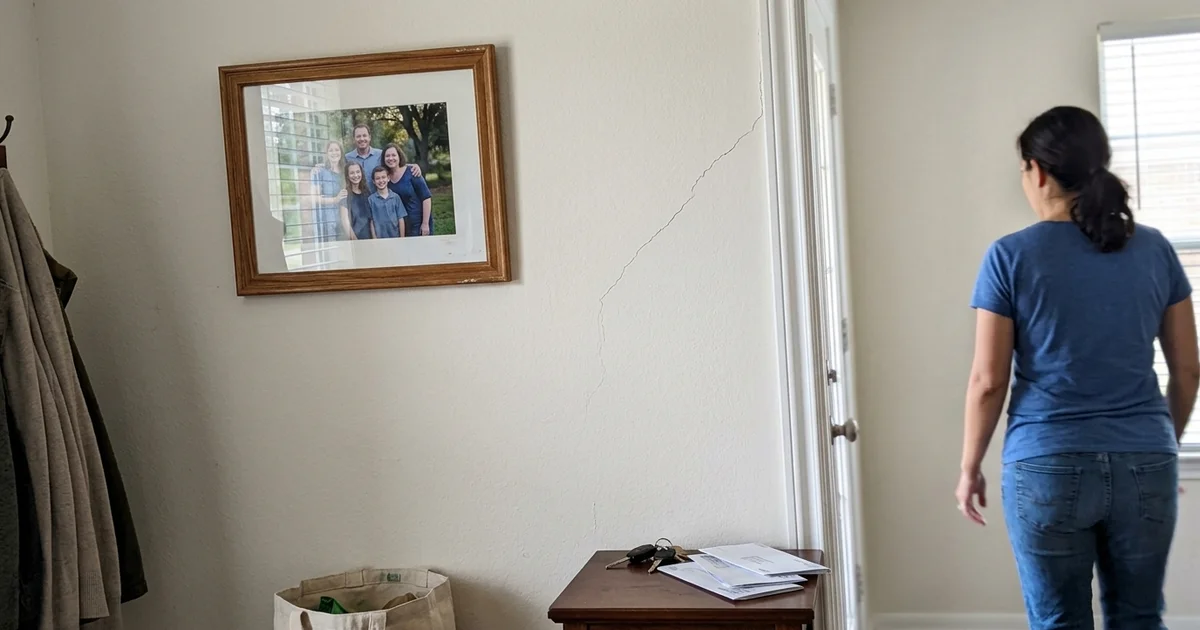
You know how frustrating it is when a freshly painted wall suddenly shows a jagged line right above the doorframe. You might wonder, why does drywall crack in the first place?
We see this constantly across Central Texas, where the ground beneath us dictates what happens to the walls around us. Austin’s boom-and-bust rainfall pattern causes significant soil movement.
Our team knows that this constant shifting flexes the framing, forcing rigid materials to snap. Understanding the root cause helps you decide whether you need drywall crack repair, a structural check, or both.
We will walk through the exact soil conditions driving this issue and outline a clear action plan for long-lasting fixes.
Expansive Clay Soils
When investigating drywall cracks, clay soil in Texas is often the primary culprit. We deal with “Houston Black” clay, a specific Vertisol common across the Blackland Prairie of eastern and central Austin.
Texas A&M AgriLife notes that this soil type can swell and shrink by up to 35 percent depending on moisture levels. Our crews often observe that after a hot, dry summer, the ground visibly pulls away from concrete slabs.
Heavy rains then flood the area, causing the soil to swell back up with tremendous force.
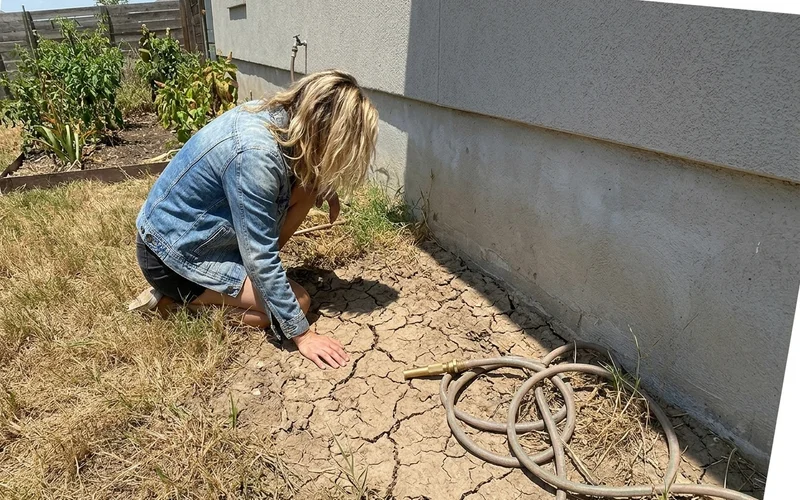
That cycle moves foundations slightly, season after season. We know the house flexes with this movement, and rigid wall materials simply crack at their weakest points.
Other Common Causes
Environmental swings and construction materials often create movement independent of the soil. We routinely find that moisture loss in wood and extreme attic temperatures are major culprits behind wall damage.
- New construction settling. Framing lumber dries and shrinks significantly during the first two years. We follow the National Association of Home Builders data, which shows dimensional lumber can shrink between 2 and 7 percent across the grain. This shrinkage pops nails and snaps taped seams.
- Temperature and humidity swings. Houses expand and contract with heat, especially in upper floors. Our inspections frequently reveal that unvented attics in August create enough thermal expansion to stress ceiling joints.
- Poor taping. Joints taped with too little compound crack easily. We see many fast-track builds where corners lack proper reinforcement.
- Roof and truss movement. Trusses flex with temperature changes. Our framing repairs often address ceiling separation caused by this thermal bowing.
- Water damage. Hidden leaks soften joint compound rapidly. The EPA states an average slab leak dumps 10,000 gallons of water into the soil yearly, accelerating foundation shift.
Where Cracks Usually Show Up
Wall stress concentrates around openings and structural transitions. We look for specific patterns to diagnose the underlying issue accurately.
| Location | Common cause | Structural Indicator |
|---|---|---|
| 45-degree diagonal from door corners | Foundation or framing movement | Racking frames |
| Along tape joints on flat walls | Movement plus weak taping | Often cosmetic |
| Ceiling joints running parallel | Truss movement, settling | Lumber shrinkage |
| Where walls meet ceilings | Truss uplift, seasonal movement | Attic temperature swings |
| Around nail heads (Nail pops) | Framing shrinkage | Normal drying |
These locations represent the weakest points in your wall system. Our technicians use these visual clues to map out exactly how a building is settling.
Cosmetic or Structural?
People often wonder if a drywall crack is structural or just a visual annoyance. We follow the International Association of Certified Home Inspectors guideline, which flags any separation wider than 1/8 inch as a potential warning sign.
Most hairline fractures under 1/16 inch are purely cosmetic shrinkage. Our experts recommend calling a structural engineer or foundation specialist first if you see:
- Gaps wider than 1/8 inch or getting steadily wider over time.
- Stair-step patterns in exterior brick or block.
- Doors or windows that stick or fail to latch properly.
- Sloping floors or visible gaps between floors and baseboards.
- Repairs that fail rapidly after a fresh patch.
- Several new fissures appearing simultaneously on one side of the property.
Our promise
If a crack looks like a sign of structural movement, we will tell you before covering it up. Patching over a structural problem only hides it.
Repairs That Last Longer
A proper fix requires re-establishing a strong, flexible bond across the seam, not just filling the gap. We avoid the fast fix of smearing a thin layer of compound over a split, because it always fails within a few months.
The standard repair process involves several critical steps to ensure durability:
- Open the crack slightly with a utility knife and remove all loose, crumbling material.
- Embed tape firmly over the joint. We rely on paper tape for corners because USG testing proves paper outperforms fiberglass mesh in shear strength during active movement.
- Apply joint compound in three thin coats. Our finishers feather each coat wider than the previous one to hide the seam.
- Sand smooth to perfectly match the surrounding texture.
- Prime and paint the full wall from corner to corner for a flawless finish.
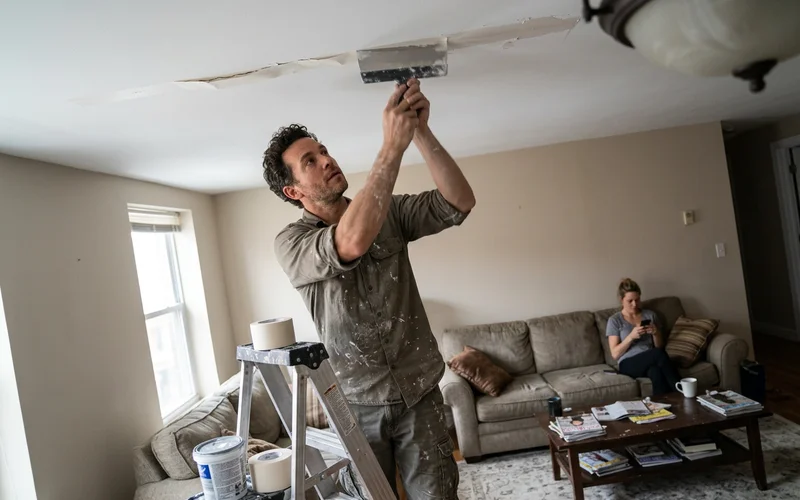
Matching the original surface texture is what makes the patch invisible. Our comprehensive guide on texture matching explains exactly how that process works.
Can You Stop Cracks From Coming Back?
You can significantly reduce recurring damage by controlling the moisture levels around your property. We advise clients to maintain consistent soil hydration to prevent the ground from expanding and contracting wildly.
Installing a soaker hose system about 18 inches away from your slab during drought conditions limits drastic soil shrinkage. Our teams also recommend routing all gutter downspouts at least five feet away from the perimeter.
A high-quality repair utilizing embedded paper tape holds up much better against minor vibrations. We remind homeowners that in active clay soils, occasional hairline stress fractures may still return over a span of several years.
Seasonal Patterns in Austin
The transition from a scorching summer to a wet autumn triggers the most aggressive soil shifts. We consistently receive a surge of repair calls in late September when the first heavy rains hit the parched ground.
The 2011 Texas drought established a clear baseline for how extended heat permanently alters local soil compaction. Our specialists note that when rain finally returns, the clay absorbs it unevenly, lifting portions of the slab while other sections remain settled.
That uneven lifting twists the framing. We consider separations that grow steadily regardless of the season to be a red flag worthy of a professional engineering opinion.
Ceiling Cracks at Interior Walls
A distinct split where the ceiling meets an interior wall is typically caused by roof truss uplift. We find this happens mostly in the winter when the attic is cold and damp, but the house interior remains warm.
The Engineered Wood Association explains that the bottom chord of the truss dries and shrinks, while the top chord absorbs attic moisture and expands. Our inspections show this imbalance causes the entire truss to bow upward, pulling the ceiling away from the partition wall.
One of the primary ceiling crack causes is this thermal difference. We often fix this by “floating” the drywall corners, which means removing screws within 16 inches of the wall so the ceiling can flex without snapping the taped joint.
Keep a Record
Documenting changes over time provides the best evidence for diagnosing a structural failure. We tell clients to take a dated photograph with a ruler held directly next to the damaged area.
Checking the width again in 60 days reveals if the movement is active or historical. Our estimators recommend using digital calipers to measure anything approaching that critical 1/8-inch threshold.
If the measurement remains perfectly stable, a standard cosmetic patch is usually all you need.
Cracks in Newer Homes
Freshly built homes undergo a natural curing process that almost always results in minor cosmetic blemishes. We constantly reassure new buyers that framing lumber requires up to two full years to reach equilibrium with the indoor environment.
The National Association of Home Builders notes that standard foundations also consolidate into the soil during this initial period. Our experience shows this is why many builders offer a one-time touch-up service at the 11-month mark of a standard warranty.
If that warranty window has closed, a careful repair using reinforced tape lasts much longer than a builder’s quick caulk job. We can provide this exact type of permanent, reinforced solution.
Exterior Clues to Check
The outside of your building often tells the true story of what is happening inside the walls. We urge property owners to walk around the exterior perimeter aligned with any interior damage.
Look closely for stair-step separations in the brick mortar, particularly gaps wider than 1/4 inch. Our crews also inspect for frieze boards pulling away from the siding or uneven gaps around window frames.
Taking photos of both the interior and exterior sides gives a structural professional a complete picture of the stress points.
Get It Looked At
A professional evaluation eliminates the guesswork and protects the value of your property. We offer free estimates to help you understand exactly what is happening behind your paint.
A transparent, fixed price is provided for all necessary patching, texture matching, and painting. Our estimators will clearly explain what damage is purely cosmetic and what might require an engineer’s input.
Contact us today to schedule your walkthrough and secure a permanent solution for your walls.